

Choosing the right candle making kit for your small business is one of the most consequential sourcing decisions you will make in year one. The wrong kit — inconsistent wick sizing, low-grade wax, or oversized MOQs — quietly eats into margins and generates customer complaints that are difficult to recover from. The right kit, on the other hand, gives you a repeatable, photogenic product that arrives retail-ready with minimal post-processing on your end. As of 2026, the wholesale candle kit market has grown significantly, with buyers across North America and Europe demanding kits that balance cost efficiency with professional finish. This guide walks through every specification that matters, so you can evaluate suppliers with confidence and place orders that actually move.
The Core Problem: Why Most Candle Kits Fail Small Businesses
Why Off-the-Shelf Candle Kits Often Fall Short
Most retail-grade candle making kits are designed for one-time hobbyist use, not repeated production. When small business owners order these at scale, they encounter three recurring problems:
- Inconsistent wick pre-tabbing — wicks that are not pre-centered or pre-tabbed add 3–5 minutes of manual labor per candle, which compounds quickly at 100+ unit runs.
- Undersized wax volumes — hobby kits typically include 200–300g of wax, enough for 2–3 candles. A business-scale batch requires at minimum 2kg per session to be cost-effective.
- No retail-ready packaging — kits that ship in plain poly bags require additional packaging investment before the product is sellable.
The Cost of Getting It Wrong
Compared to purpose-built wholesale kits, hobby kits sourced individually can increase per-unit prep time by roughly 40–60%. At a production rate of 50 units per week, that translates to several additional hours of labor that could be redirected to marketing or fulfillment.
The solution is not simply buying more hobby kits — it is sourcing kits designed from the ground up for small-scale commercial production, with pre-assembled components, consistent specs, and MOQs that match your actual run size.
Key Specifications to Evaluate in Any Candle Making Kit
Wax Type and Volume
Wax is the single largest variable in candle performance. The three most common types in wholesale kits are soy, paraffin, and a soy-paraffin blend. Each has a different melt point, scent-throw profile, and shrinkage rate.
| Wax Type | Melt Point | Typical Scent Throw | Shrinkage on Cool |
| Soy (100%) | 49–54°C | Moderate | Low (~3–5%) |
| Paraffin | 52–58°C | High | Moderate (~8–10%) |
| Soy-Paraffin Blend | 50–56°C | High | Low–Moderate |
For a small business producing 50–200 candles per week, look for kits that include at minimum 1kg of wax per unit batch and clearly state the wax blend ratio on the product spec sheet.
Wick Specifications
Wick diameter must be matched to container diameter. A mismatch causes tunneling (wick too small) or excessive soot and mushrooming (wick too large). When evaluating kits, confirm:
- Wick diameter range is documented (e.g., suitable for containers 6–8cm diameter)
- Wicks are pre-tabbed with a metal sustainer to hold position during pour
- Wick material is cotton or cotton-paper braided — avoid zinc-core wicks in scented candle applications
- Kit includes at minimum 10–20 wicks to support a meaningful production run
Fragrance and Additives
Fragrance load — the percentage of fragrance oil relative to wax weight — typically runs 6–10% for soy wax and up to 12% for paraffin. Kits that do not disclose fragrance load percentages are a red flag. Confirm the kit's fragrance oil is cosmetic or candle-grade, not industrial, especially if your end product will be used in enclosed spaces like spa or home décor settings.
Wick Maintenance Tools: A Non-Negotiable Kit Component
Why Wick Tools Matter for Product Quality
A candle kit without wick maintenance tools is incomplete for any business positioning its product as premium or gift-worthy. Customers who purchase artisan candles expect — and increasingly receive — proper wick care tools as part of the product experience.
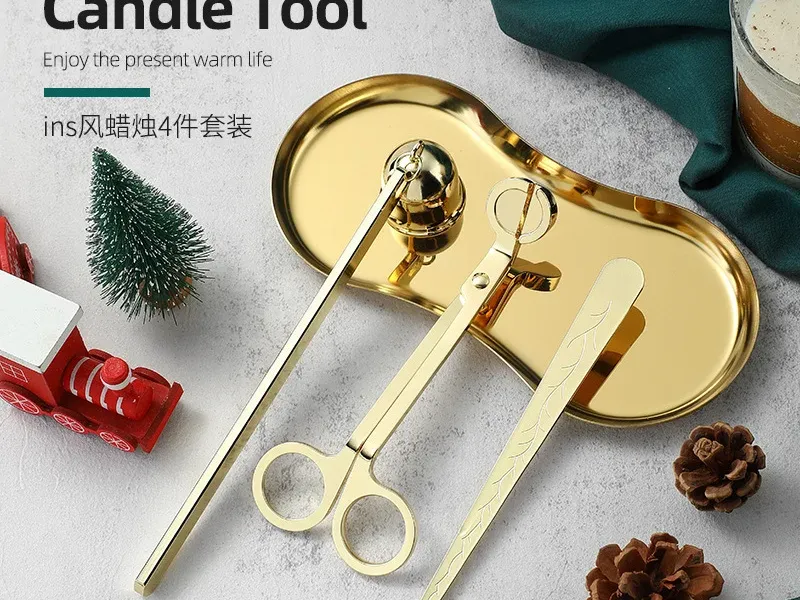
The current industry standard for a complete candle care set includes three core tools:
- Wick trimmer (scissor-style): Trims wicks to the recommended 5–6mm before each burn, preventing soot buildup and mushrooming
- Bell snuffer: Extinguishes candles without wax splatter or smoke — the professional alternative to blowing out a flame
- Wick hook/dipper: Repositions a drowning wick and can be used to extinguish candles by dipping the wick into the melt pool
For wholesale buyers, the Christmas DIY Candle Wick Trimmer & Snuffer Tool Set is a purpose-built 3-piece stainless steel set (304/316 grade, mirror-polished, rust-resistant) available in five finishes — silver, gold, rose gold, black, and antique bronze — making it straightforward to match any candle brand's aesthetic.
Comparing Tool Sets
| Feature | Basic Wick Trimmer Only | 3-Piece Stainless Set |
| Wick trimming | Yes | Yes |
| Clean extinguishing | No | Yes (bell snuffer) |
| Wick repositioning | No | Yes (hook tool) |
| Gift presentation value | Low | High |
| Finish options | Usually 1 | 5 options |
Including a 3-piece tool set with your candle kits increases perceived value and reduces the most common customer complaint: soot and tunneling caused by improper wick maintenance.
Packaging, MOQ, and Wholesale Sourcing Considerations
Packaging Requirements for Retail and DTC Channels
For small businesses selling through retail, Etsy, Amazon, or subscription boxes, packaging is not cosmetic — it is functional. A kit that arrives in retail-ready packaging eliminates one production step and reduces your per-unit cost. When evaluating wholesale candle kits, ask for:
- Individual box dimensions — confirm the packaged unit fits standard shelf or mailer box formats
- Branded insert capability — can the supplier include your logo card or instruction insert?
- OEM and private label options — at what MOQ does private labeling become available?
MOQ Guidance by Business Stage
Minimum order quantities vary significantly across suppliers. As a rough benchmark for 2026:
| Business Stage | Recommended Kit MOQ | Notes |
| Pre-launch / testing | 50–100 units | Validate product-market fit before committing |
| Early growth | 100–500 units | Begin negotiating mixed-SKU assortments |
| Established (6+ months) | 500+ units | Custom packaging becomes cost-effective |
We work with buyers at all stages and can discuss mixed-assortment orders to help you test multiple kit configurations without committing to a single SKU at high volume.
Export and Shipping Considerations
For buyers sourcing internationally — particularly those serving North American and European markets — confirm that your supplier provides:
- Material Safety Data Sheets (MSDS) for fragrance oils and wax components
- HS code documentation to simplify customs clearance
- Carton dimensions and gross weights for accurate freight quoting
Export-ready documentation from your supplier reduces customs delays and is a marker of a professional wholesale operation versus a gray-market reseller.
How to Evaluate a Candle Kit Supplier: A Practical Checklist
Supplier Evaluation Framework
Before placing a wholesale order, run every prospective candle kit supplier through this checklist. It takes roughly 15–20 minutes per supplier and saves significant time resolving issues post-shipment.
Product Specification Checklist
- [ ] Wax type and blend ratio clearly documented
- [ ] Wick diameter range specified and matched to included container size
- [ ] Fragrance load percentage disclosed (target: 6–10% for soy, up to 12% for paraffin)
- [ ] Component count per kit itemized (wax weight, wick count, fragrance volume in ml)
- [ ] Burn time estimate provided and methodology stated
- [ ] Wick maintenance tools included or available as add-on SKU
Supplier Capability Checklist
- [ ] Samples available before bulk order commitment
- [ ] MOQ aligns with your current production volume
- [ ] Private label or OEM available (confirm minimum unit threshold)
- [ ] Export documentation available (MSDS, HS codes, packing list)
- [ ] Reorder lead time stated in writing
- [ ] Mixed-SKU assortment orders accepted
Red Flags to Watch For
- Specs listed only in marketing language with no measurable values
- No sample program — suppliers confident in their product offer samples
- MOQ dramatically higher than your current volume with no flexibility
- No documentation of fragrance oil grade or wax sourcing
- Lead time given as a range wider than 4 weeks without explanation
The Candle Making Kits collection at KitsNest is built around suppliers that meet every item on this checklist. We review specs on each batch and only carry kits where the documentation supports the product claim.
Frequently Asked Questions
What wax type is best for a small business candle making kit?
Soy-paraffin blends are the most practical choice for most small businesses as of 2026. Pure soy wax has a clean-burning reputation and markets well to eco-conscious consumers, but it has a lower scent throw and requires slower cooling to avoid sinkholes — which adds time to your production process. Paraffin delivers stronger scent throw but faces increasing consumer resistance in premium and gift markets. A 70/30 or 80/20 soy-paraffin blend gives you the best of both: strong scent throw, clean label appeal, and predictable pour behavior. Whatever wax type you choose, confirm the melt point and fragrance load percentage before ordering at scale.
What is a reasonable MOQ for wholesale candle making kits?
For small businesses in an early or testing phase, a minimum order quantity of 50–100 units per SKU is reasonable and gives you enough volume to validate the product without overcommitting inventory. Once you have confirmed product-market fit and are producing consistently, MOQs of 100–500 units become more cost-effective per unit. For private label or custom packaging, most suppliers require 200+ units before customization is viable. Always ask whether a supplier will allow mixed-SKU assortments — this lets you test multiple kit configurations at a combined MOQ rather than hitting minimums on each SKU individually.
Should candle making kits for a small business include wick trimming tools?
Yes — including wick care tools significantly increases perceived product value and reduces post-purchase complaints. The most common candle complaints (soot, mushrooming, tunneling) are almost entirely caused by improper wick maintenance, not a defect in the candle itself. Offering a 3-piece stainless steel set — trimmer, bell snuffer, and wick hook — as part of your kit or as an add-on positions your product as complete and professional. It also gives customers a tangible reason to spend more per order. A quality stainless steel 3-piece set in a polished finish adds genuine shelf appeal and photographs well for DTC and social commerce channels.
How do I verify that a wholesale candle kit supplier is export-ready?
Ask the supplier for three specific documents before placing an international order: a Material Safety Data Sheet (MSDS) for the fragrance oil and wax components, the HS code for the finished kit, and a sample packing list with carton dimensions and gross weights. A supplier who can produce all three within 24–48 hours is operating at a professional export level. If any of those documents require more than a week to produce — or if the supplier has never prepared them — treat that as a signal that their export process is not yet mature. Export-ready documentation also simplifies your customs clearance and reduces the risk of shipment holds at the border.
Can I order candle making kits with custom or private label packaging for my brand?
Most wholesale candle kit suppliers offer private label or OEM packaging options, but the minimum unit threshold varies. In practice, custom packaging — your logo, brand colors, and product copy on the box — typically becomes available at 200+ units per SKU. Below that threshold, most suppliers offer standard packaging with an insert card slot where you can place a branded card. If you are sourcing mixed-kit assortments, confirm whether private label MOQ applies per SKU or per combined order total, as some suppliers will apply the threshold to the total order rather than each individual kit configuration. This can make custom packaging accessible at lower per-SKU volumes.
Related Resources
Related Collections
Related Craft Families
Related Solutions
A practical sourcing guide for wholesale candle craft kits that scale with your business
Browse Wholesale Candle Making Kits for Your Business