

Choosing the right wick determines whether a candle burns evenly, throws scent properly, or tunnels and drowns halfway through its life. For sellers building candle making kits, wick selection sits alongside wax type and container diameter as one of the three variables that decide burn quality. This guide walks through the practical factors — diameter matching, material differences, testing steps, and maintenance tools — that go into a reliable wick decision for kit assembly, whether you're sourcing for retail-ready kits, private-label programs, or classroom workshop sets. We approach this from a kit-supply perspective: what matters when you're speccing wicks at volume, not just lighting one candle at home.
Why Wick Selection Is the Hardest Part of Candle Kit Sourcing
The Core Problem
A mismatched wick is the single most common cause of candle failure — either the flame drowns in melted wax (wick too small) or it flares, smokes, and tunnels down the center leaving unmelted wax on the outer walls (wick too large). Unlike wax or fragrance oil, wick performance is size- and container-specific, so a wick that works in a 3-inch tin will not perform the same in a 4-inch jar.
- Container diameter is the primary variable — every 1-inch change in diameter typically requires a different wick size
- Wax type (soy, paraffin, blended) changes melt pool behavior and therefore wick draw
- Additives like fragrance oil and dye load can slow or accelerate burn rate, shifting the ideal wick size
Compared to sourcing wax or containers, wick specification requires the most iterative testing — as of 2026, most experienced kit assemblers run 2-3 burn tests per new container/wax combination before locking in a final wick size for production.
Matching Wick Type to Wax and Container
Common Wick Materials
- Cotton braided wicks — the industry standard for paraffin and many soy blends; consistent burn, widely available
- Cotton core with paper or zinc thread — adds rigidity so the wick stays upright in softer waxes
- Wood wicks — wider flame profile, crackling effect, generally suited to wider, shallow containers rather than tall narrow ones
Sizing by Container Diameter (General Reference)
| Container Diameter | Typical Wick Consideration |
| Under 2.5 in | Single small-to-medium wick |
| 2.5 in – 3.5 in | Single medium wick or dual-wick setup |
| Over 3.5 in | Dual or triple wick configuration |
This table is a starting reference, not a fixed rule — wax type and fragrance load shift the ideal size within each range. Unlike a one-size-fits-all approach, kits assembled for retail-ready or subscription box programs need documented wick-to-container pairings so quality stays consistent across production batches, not just the first prototype.
Testing and Adjusting Your Wick Choice
What to Check During a Burn Test
- Melt pool width: wax should melt edge-to-edge within the first burn (roughly the first 2-4 hours) without tunneling
- Flame height: a steady flame of roughly 1-2 cm is generally a sign of correct sizing; taller, flickering flames often mean the wick is oversized
- Soot and mushrooming: a wick tip that balls up and blackens after 30-60 minutes typically signals it's too large for the wax/container combination
Comparison: Too Small vs. Too Large
| Symptom | Wick Too Small | Wick Too Large |
| Melt pool | Narrow, tunnels down center | Wide but excessive smoke |
| Flame | Weak, may self-extinguish | Tall, flickering, sooty |
| Scent throw | Poor — not enough heat | Can be strong but unstable |
We run these checks every time we assemble a new kit configuration — it's a repeatable process, not guesswork, and it's what separates a kit that performs consistently across a production run from one that only works on the sample unit.
Maintenance Tools That Extend Wick Performance
Why Trimming Matters
Even a correctly sized wick needs regular trimming to keep the flame stable across the candle's full burn life. A wick left untrimmed after each burn tends to mushroom and produce more soot, which affects both flame height and scent throw over time.
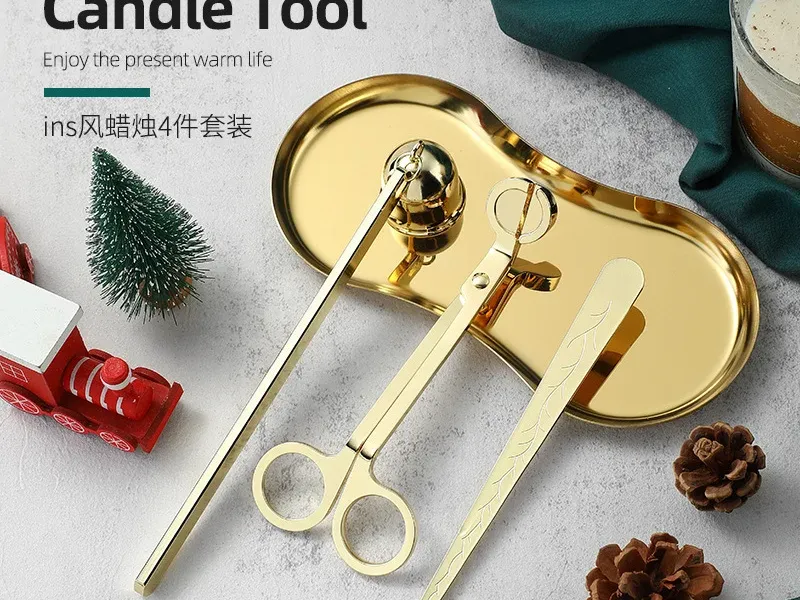
The Christmas DIY Candle Wick Trimmer & Snuffer Tool Set is a 3-piece stainless steel set — wick trimmer, bell snuffer, and wick hook — built from 304/316-grade stainless steel with a mirror-polished, rust-resistant finish. Each set weighs approximately 150-200g and is available in five finishes (silver, gold, rose gold, black, antique bronze), which makes it straightforward to match kit packaging aesthetics across a product line.
- Wick trimmer: scissor-style cutter, ~18-20cm length, trims the wick to the recommended height between burns
- Bell snuffer: cone-shaped extinguisher, ~18-20cm length with a 4-5cm bell diameter, snuffs the flame without scattering hot wax
- Wick hook: ~18-20cm curved tool for repositioning the wick before the wax sets
Compared to bundling loose accessories, including a maintenance tool set inside Candle Making Kits gives end users a complete, self-contained burn-care routine rather than requiring a separate purchase — a detail that matters for Retail Ready Kits and Subscription Box Kits where the unboxing experience is part of the value proposition.
Sourcing Wick Accessories for Kit Production at Scale
Building This Into a Kit Program
For brands developing candle kits for Amazon Seller Kits, Private Label Craft Kits, or OEM Craft Kits programs, wick-related accessories are one of the easiest components to standardize across SKUs because trimmer and snuffer tools aren't wax- or container-dependent the way wick sizing is.
- Finish options (silver, gold, rose gold, black, antique bronze) allow accessory sets to be matched to different kit tiers or seasonal packaging without changing tooling
- A consistent 150-200g set weight simplifies freight and packaging calculations across mixed shipments
- Pairing a maintenance tool set with a documented wick-sizing reference sheet reduces after-sale support inquiries related to poor burn performance
As of 2026, kit assemblers serving both North American and European markets increasingly treat wick maintenance tools as a standard inclusion rather than an upsell, since it directly affects the end user's perceived burn quality and repeat purchase likelihood.
Frequently Asked Questions
What size wick do I need for my candle container?
Wick size depends primarily on container diameter, with wax type and fragrance load as secondary factors. As a general reference: containers under 2.5 inches typically use a single small-to-medium wick, 2.5-3.5 inch containers often need a medium wick or dual-wick setup, and containers over 3.5 inches usually require dual or triple wicks. Always confirm with a burn test since wax and fragrance additives shift these ranges.
How do I know if my wick is too big or too small?
A wick that's too small produces a narrow melt pool that tunnels down the center, with a weak flame that may self-extinguish. A wick that's too large creates excessive smoke, a tall flickering flame, and soot buildup with mushrooming at the tip within 30-60 minutes of burning. The correct size melts wax edge-to-edge within the first 2-4 hour burn with a steady 1-2 cm flame.
What's the difference between cotton and wood wicks?
Cotton braided wicks are the industry standard for paraffin and many soy blends, offering a consistent burn and wide availability. Wood wicks produce a wider flame profile with a crackling effect and generally suit wider, shallow containers better than tall, narrow ones. Cotton wicks with paper or zinc-thread cores add rigidity, keeping the wick upright in softer waxes.
Why should a candle kit include wick maintenance tools?
Even a correctly sized wick needs regular trimming to maintain flame stability and reduce soot across the candle's burn life. Including a maintenance set, such as a 3-piece stainless steel trimmer, snuffer, and hook set, gives end users everything needed for proper wick care in one package rather than requiring a separate purchase — which improves the unboxing and usage experience for retail-ready and subscription kits.
How often should I trim a candle wick?
Trim the wick to the recommended height before each burn, typically after the wax has fully cooled from the previous burn. Untrimmed wicks tend to mushroom and produce more soot over time, which reduces flame stability and scent throw. A dedicated wick trimmer, like the scissor-style cutter in a 3-piece stainless steel tool set, makes this a quick, repeatable step.
Related Resources
Related Collections
Related Craft Families
Related Solutions
A practical, spec-driven guide to matching wick type and size to your candle project
Request Wholesale Candle Kit Sourcing Support