
Sourcing candle making kits at scale is a fundamentally different challenge from buying a single retail set. Whether you are stocking an e-commerce store, curating subscription boxes, or supplying educational workshops, the supplier you choose determines component consistency, packaging quality, and your ability to scale without disruption. As of 2026, the global DIY craft kit market has expanded significantly, and the number of suppliers claiming wholesale capability has grown with it — making due diligence more important than ever. This guide breaks down the critical criteria buyers should evaluate before committing to a candle making kit supplier, drawing on real sourcing experience across wholesale, OEM, and private-label channels.
Component Quality and Material Traceability
Why Component Specs Matter More Than the Box
The most common complaint we hear from buyers who switched suppliers is inconsistency — wicks that vary in thickness batch to batch, wax blends that behave differently across orders, or fragrance oils that arrive unlabeled. A reliable candle making kit supplier documents every component.
Key Components to Evaluate
- Wax type and blend ratio: Specify whether you need soy wax, paraffin, coconut, or blended. Ask for the exact blend ratio (e.g., 70% soy / 30% paraffin) and whether it is consistent across production runs.
- Wick specifications: Cotton wicks should be pre-tabbed and sized for the intended vessel diameter. A 6oz jar typically requires a CD-18 or ECO-6 wick; a 12oz jar requires a larger CD-22 or equivalent. Mismatched wicks are one of the top causes of customer returns.
- Fragrance or essential oil load: Industry standard for scented candles is 6–10% fragrance load by weight. Kits that omit this spec often under-fill, resulting in weak scent throw and dissatisfied end users.
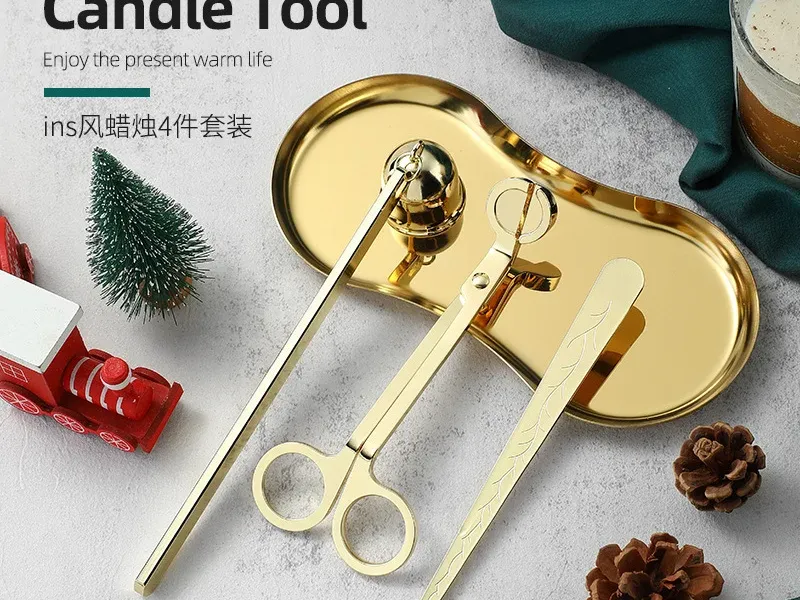
- Wick trimmer and tool quality: If the kit includes accessories such as a wick trimmer or snuffer, material grade matters. Look for 304 or 316 stainless steel — the same standard used in our Christmas DIY Candle Wick Trimmer & Snuffer Tool Set, which features a mirror-polished, rust-resistant finish and weighs approximately 150–200g per set — substantial enough to feel premium without being cumbersome.
Comparison: Documented vs. Undocumented Components
| Criteria | Documented Supplier | Undocumented Supplier |
| Wax blend consistency | Same ratio every batch | Variable, unreliable |
| Wick sizing | Matched to vessel diameter | Generic, one-size |
| Fragrance load | Stated % by weight | Unlabeled or estimated |
| Tool material grade | Stainless steel grade listed | Unknown alloy |
| Reorder reliability | Spec-locked SKUs | Changes without notice |
Compared to suppliers who ship pre-assembled kits without component documentation, a spec-transparent supplier reduces QC failures by a significant margin — in our experience reviewing incoming batches, undocumented kits generate roughly 3–5x more customer escalations per 1,000 units shipped.
Minimum Order Quantities and Scalability
Matching MOQ to Your Business Stage
One of the first questions any buyer should ask is: what is the minimum order quantity, and does it align with your current sales velocity and storage capacity? A supplier with a 5,000-unit MOQ is not suitable for a subscription box operator running 500 boxes per month. Equally, a supplier who caps production at 200 units per SKU cannot support a retail chain reorder.
MOQ Tiers to Expect (As of 2026)
- Entry-level wholesale: MOQ of 50–100 units per SKU — appropriate for Amazon sellers testing new SKUs, boutique retailers, or workshop organizers.
- Mid-volume wholesale: MOQ of 200–500 units — typical for subscription box operators, regional distributors, and educational suppliers.
- OEM / private label: MOQ often starts at 200+ units for custom packaging and 500+ units for custom component formulation or branded accessories.
Scalability Signals to Request
- Production lead time transparency: Ask for documented production windows, not verbal estimates. A supplier managing export orders should be able to provide batch scheduling information.
- Reorder consistency: Can they guarantee the same wax blend, wick lot, and fragrance source across reorders? Request a specification lock or formulation record.
- Mixed-SKU assortments: For buyers who need variety without hitting per-SKU MOQs, ask whether mixed-color or mixed-design assortments are available. This is standard practice in the Candle Making Kits wholesale segment and significantly reduces inventory risk.
Scaling Comparison
| Buyer Type | Recommended MOQ Range | Key Concern |
| Amazon Seller | 50–100 units | Per-unit cost, packaging |
| Subscription Box | 200–500 units/month | Consistency, cadence |
| Educational Supplier | 100–300 units | Safety, age-appropriateness |
| Retail Chain | 500–2,000 units | Reorder speed, spec lock |
| OEM / Private Label | 200+ units | Brand customization depth |
OEM, Private Label, and Customization Capability
Why Customization Depth Separates Commodity from Premium Suppliers
Any wholesale supplier can ship a generic candle making kit. What differentiates a strategic sourcing partner is the depth of customization they can execute — and the minimum order at which that customization becomes viable.
Customization Dimensions to Evaluate
- Packaging: Can they print your logo on the outer box? Accept your dieline? Use your brand color palette? Custom packaging typically activates at 100–200 units with a credible supplier.
- Component selection: Can you specify your own wax blend, wick brand, fragrance oil, and vessel shape — or are you locked into their pre-configured kit? True OEM capability means you approve every component.
- Accessory branding: Engraved or printed tools (wick trimmers, snuffers) with your brand mark are achievable at 200+ units with suppliers who do in-house metal finishing.
- Instruction booklet: Full-color, photo-based instruction cards in your brand voice and language — not a generic black-and-white insert.
- Gift-ready presentation: Tissue paper, ribbon, branded tags, and retail-ready packaging that requires zero prep on your end.
OEM vs. White Label vs. Wholesale: A Quick Comparison
| Type | Customization Level | Typical MOQ | Best For |
| Wholesale (stock) | None — sell as-is | 50–100 units | Quick-turn resellers |
| White Label | Packaging only | 100–200 units | Brand-builders |
| OEM | Full component + pack | 200–500 units | Premium brands |
| Full Custom | Formula + design | 500+ units | Exclusive product lines |
Buyers sourcing for Private Label Craft Kits or OEM Craft Kits should request a sample of a supplier's existing private-label work — not just a catalog. Seeing a finished, packaged kit in hand reveals quality gaps that no spec sheet discloses.
Packaging Integrity and Retail Readiness
The Hidden Cost of Poor Packaging
For buyers selling through retail channels or fulfilling subscription boxes, packaging is not cosmetic — it is functional. Kits that arrive with damaged inserts, spilled fragrance oils, or loose wicks generate returns, negative reviews, and reshipment costs that erode margin quickly.
Packaging Criteria to Assess
- Inner component separation: Liquid fragrance oils and wax blocks must be independently contained and sealed. Leakage during transit is a recurring issue with suppliers who use single-layer poly bags without secondary containment.
- Outer box crush resistance: For Amazon FBA and retail shelf display, the outer carton needs to withstand 32–40 lbs ECT (Edge Crush Test) standard or equivalent. Ask for box material spec.
- Retail barcode readiness: Does the supplier apply EAN/UPC barcodes at the correct position and scan reliably? This is non-negotiable for Retail Ready Kits and Amazon Seller Kits.
- Insert card quality: Full-color, laminated instruction cards (minimum 250gsm coated stock) signal production investment. Thin, monochrome inserts are a reliable indicator of cost-cutting elsewhere in the kit.
- Fragrance containment: Essential oils and fragrance oils are regulated for air freight. A supplier experienced in export logistics should pre-comply with IATA Packing Instruction 650 for liquid volumes under 1 liter.
Packaging Checklist for Buyers
- [ ] Inner component separation confirmed (no cross-contamination)
- [ ] Outer carton crush test spec provided
- [ ] Barcode placement and scan rate verified
- [ ] Instruction card print quality sampled
- [ ] Fragrance oil containment compliant with export regulations
- [ ] Unboxing experience reviewed via physical sample
Supplier Verification and Long-Term Partnership Indicators
Beyond the First Order: What Makes a Supplier a Partner
A single successful order does not confirm a reliable supplier. The indicators of a long-term sourcing partner are visible in how a supplier handles complexity, change, and communication — not just in their initial pitch.
Verification Steps Before Committing
- Factory audit or third-party inspection: Request a factory audit report or arrange an independent inspection (SGS, Bureau Veritas, or equivalent) for orders above 500 units. This is standard practice for export-quality sourcing.
- Sample order protocol: A credible supplier offers a formal sample program — not just a free promotional kit. Samples should reflect production-run quality, not showroom-grade exceptions.
- Communication responsiveness: Track response time across time zones. A supplier managing export orders to North America and Europe should respond within 24 hours on business days. Consistent delays at the inquiry stage predict operational delays later.
- Reference batches and production records: Ask to see QC reports from a recent production run — weight variance logs, component inspection records, and packaging rejection rates.
- Export experience: Suppliers shipping from manufacturing hubs such as Ningbo, China (a documented origin for several KitsNest products) should be fluent in export documentation — commercial invoices, packing lists, certificate of origin, and customs HS code classification.
Red Flags to Watch
- Inability to provide a component specification sheet
- No formal sample program — only verbal assurances
- MOQ flexibility that seems unusually generous without explanation
- Packaging photos that never show actual production units
- No documented QC process for fragrance oil fill weights or wick lot consistency
For buyers sourcing across multiple craft categories — from Candle Making Kits to Soap Making Kits — consolidating with a multi-category supplier who maintains consistent quality standards across SKUs reduces audit overhead and simplifies logistics considerably compared to managing 4–6 single-category vendors.
Frequently Asked Questions
What minimum order quantity should I expect from a candle making kit supplier?
Entry-level wholesale typically starts at 50–100 units per SKU, which suits Amazon sellers or boutique retailers testing new products. Mid-volume buyers such as subscription box operators generally work with MOQs of 200–500 units. OEM and private-label programs that include custom packaging or branded accessories commonly require 200+ units as a starting point. Always confirm whether mixed-SKU assortments are available, as these allow you to spread MOQ across multiple variants without excess single-SKU inventory.
How do I verify that a candle making kit supplier's components are consistent across reorders?
Request a written component specification sheet before placing any order. This should document wax blend ratio, wick diameter and material, fragrance load percentage by weight, and tool material grades (e.g., 304 stainless steel for trimmers and snuffers). Ask whether the supplier operates specification-locked SKUs — meaning the formulation and component sourcing are frozen for your SKU unless you approve a change. For ongoing programs, request QC batch reports from each production run showing weight variance, wick lot numbers, and inspection rejection rates.
Can candle making kit suppliers handle custom branding and private-label packaging?
Yes — the majority of export-experienced candle making kit suppliers offer at least white-label packaging (your logo on their stock box) from around 100–200 units. Full OEM, where you specify every component and the packaging is built to your dieline, typically activates at 200–500 units depending on the supplier's production setup. For premium presentation, ask specifically about full-color instruction cards, branded wick trimmers, and gift-ready inserts. Always request a pre-production sample of your branded packaging before approving mass production.
What packaging standards should candle making kits meet for retail and Amazon FBA?
For retail shelf and Amazon FBA, the outer carton should meet a minimum 32–40 lbs Edge Crush Test (ECT) standard to survive palletizing and conveyor handling. Fragrance oils and liquid components must be independently sealed with secondary containment to prevent leakage in transit. The outer packaging must carry a scannable EAN or UPC barcode at the correct placement position. Instruction cards should be at minimum 250gsm coated stock to project retail-grade quality. If the kit includes fragrance oils, confirm the supplier is compliant with IATA Packing Instruction 650 for air freight.
What are the most important red flags when evaluating a new candle making kit supplier?
The most actionable red flags include: inability to provide a written component specification sheet; no formal sample program with production-representative units; packaging photos that show only studio renders rather than actual production units; no documented QC process for fragrance fill weights or wick lot consistency; and communication response times exceeding 24 business hours on initial inquiries. Unusually flexible MOQs without clear explanation can also indicate a trading company reselling without production control, which introduces specification variability risk. Always verify export documentation capability — a supplier unfamiliar with commercial invoice requirements or HS code classification is unlikely to be experienced in international wholesale fulfillment.
Related Resources
Related Collections
A professional buyer's guide to sourcing quality candle making kits at wholesale scale
Request a Wholesale Candle Kit Quote Today